- Internal management systems: HR, attendance, task assignment, approvals, inventory and orders, following your own approval flow and permissions.
- Customer and sales management: customer records, opportunities, quotes, contracts and after-sales care.
- Customer and partner portals: customers look up orders, contracts and balances or raise support requests; resellers order against their own price lists.
- Integrations with the software you already use: accounting, e-invoicing, payment gateways and company email, through an API or by reading data directly.
- Mobile apps for staff: attendance, field reports, task notifications and push alerts on iOS and Android.
- Automation and AI: generated reports, document reading and question answering over internal data, with logs and a human approver.
Custom software development in Vietnam
ALODEV designs and builds custom software for companies that have outgrown spreadsheets and off-the-shelf tools: web applications, iPhone and Android apps, and internal systems for sales, operations and HR. Each system is written around your own processes, built in two-week iterations that each end with a working build, and handed over with its source code, database and documentation. Projects are fixed price, quoted after a free discovery.
Summary
- Typical timeline
- Websites 3-8 weeks, mobile apps 10-16 weeks, a first core business system 8-20 weeks
- Backend
- Go or Node.js (NestJS)
- Web
- Next.js, React, TypeScript
- Mobile
- React Native (Expo); Swift and Kotlin for native apps
- Database
- PostgreSQL
- Ownership
- Source code, data and accounts in your company's name
- Working language
- English, including all documentation
What we build
When custom software makes sense
Custom software is not always the right answer, and we say so in discovery even when it makes the project smaller. The two lists below are the ones we use.
Build your own when
- Your process is a competitive advantage, and forcing it into packaged software would lose that advantage.
- You pay for several disconnected subscriptions and staff re-enter the same data in each of them.
- Per-user subscription fees, as headcount grows, exceed the cost of owning a system.
- Your data has to stay on your own servers for security or legal reasons.
- The packaged software you use has no API to connect it with other systems.
Buy off the shelf when
- The process is standard and existing software already covers most of it.
- You need something working within days, with no time for discovery.
- The budget only covers a monthly subscription.
- The process is not settled yet, and trying an existing product will show what you actually need.
Technology we use, and why
The stack below is what we use in our own systems and propose by default. Every part is mainstream and open, so your company is not tied to ALODEV to maintain it.
| Layer | Technology | Why |
|---|---|---|
| Web front end | Next.js, React, TypeScript | Fast page loads, good for search engines, and a large developer community, so others can take over. |
| Backend and API | Go or Node.js (NestJS) | Go for systems with many concurrent users on modest hardware; Node.js when sharing one language with the front end matters more. |
| Database | PostgreSQL | Open source with no license fee, point-in-time backups and row-level access control. |
| Mobile apps | React Native (Expo); Swift, Kotlin | One codebase for both platforms by default; native code when the app depends on device features. |
| Servers and network | Linux, servers in Vietnam or in the cloud | Chosen by data residency requirements and running budget. |
Native, cross-platform or a wrapped website
For mobile, the first question is how people will actually open the app. An app is worth building when at least two of these hold: people open it several times a day; push notifications are central to the work, such as a new order or an approval waiting; or it needs device hardware such as the camera, location, Face ID, barcode scanning or background processing. Below that bar, a website that works well on phones is usually the better first step.
When an app is justified, React Native gives one codebase and one round of testing for both platforms, and suits teams that already work in React. Native Swift and Kotlin suit apps used every day that rely on device features. A web page wrapped in an app shell is quick to ship but risks rejection under Apple's App Review Guideline 4.2, which requires apps to offer more than a repackaged website, so we keep it for short-lived internal tools.
Connecting to existing systems
Older software without an API can usually still be connected, either by reading its data directly or through scheduled exports. We check this during discovery, before quoting, so the integration is not a surprise halfway through the project.
Software we build and run ourselves
The clearest evidence of how we build is the software we depend on. ALODEV AIO is the operations system ALODEV runs every day for attendance, task assignment, approvals, leave, payroll, notifications, chat and documents. It has a Go backend with about 500 API routes, a native iPhone app in SwiftUI for iOS 17 and later with no third-party libraries, and an Android app in Kotlin with Jetpack Compose that is distributed internally.
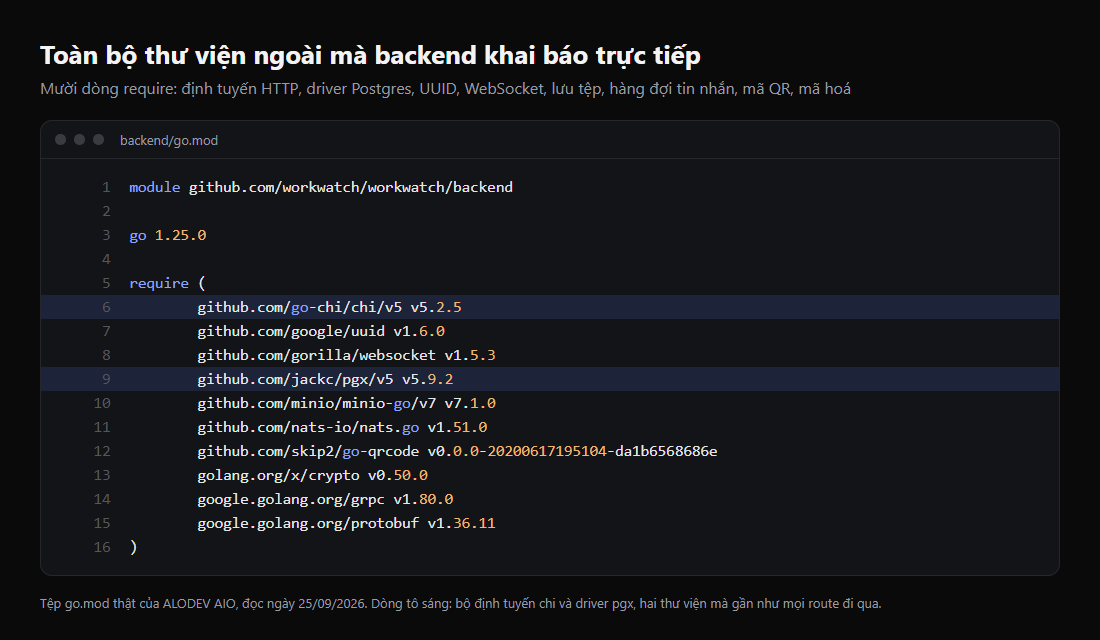
Running it ourselves has taught us things we now apply to client projects. On 5 September 2026 we counted 403 clock-ins over 30 days: 367 of them, or 91%, came from a web browser, and the two mobile apps together accounted for 15. Staff work at computers and clock in there, which is why we build the web version of a business system first and add an app for what phones do better. Native code also has a cost: on 25 September 2026 the two native apps together came to 89,193 lines for one set of business rules, and every change to those rules has to be made twice.
ALODEV also publishes apps on the Apple App Store under the developer name ALODEV CO.,LTD.
How a project is delivered
Every custom software project runs on the same terms: a fixed price agreed per milestone, payment in three installments of 30%, 40% and 30% tied to acceptance of a working system, a lifetime warranty on delivered code, and source code, data and service accounts in your company's name. The details, including how scope changes are handled and what happens if a contract ends early, are on our software outsourcing page.
Process
Discovery
2-3 days · free of chargeSessions with your management and the people who will use the system; review of current processes and software.
- Working session with management
- Review of existing software and data
- Bottlenecks listed by business impact
Proposal
7 daysCurrent-state report, scope of each milestone, timeline and the metrics each milestone is measured by.
- Current-state report
- Roadmap in priority order
- Timeline and metrics per item
Build
By milestoneTwo-week iterations, each ending with a working build you can try; acceptance at every milestone.
- Plan for every two-week iteration
- Code review and testing before merge
- Task and bug list shared with your team
Handover
After acceptanceSource code, database and documentation in your company's name, plus role-based training.
- Source code in your own repository
- Operations documentation and admin manual
- 3 to 5 training sessions
Payment
- 30%Contract signedScope and schedule of each milestone agreed
- 40%Main features in trialSystem running on your real data
- 30%Final acceptance, handoverSource code, database and documentation handed over
Handover
- Source code repository with full change history, top-level admin rights held by your company
- Database with its schema, backups and restore procedure
- Server, domain, Apple Developer and Google Play accounts registered in your company's name
- Technical documentation in English: architecture, database, deployment; admin and user manuals
- Design files, illustrations and written content
- Deployment guide another team can follow to rebuild the system on a new server
Ownership
Source code in your company's name · No license fees · 3 to 5 operator training sessions
Warranty
Lifetime warranty · Critical incidents: response within 1 hour · Compensation if we miss the schedule
Payment
Acceptance at every milestone · 3 installments, each with an invoice
Frequently asked questions
How long does custom software development take?
It depends on scope. Discovery takes 2-3 days and the proposal 7 days, after which we work in two-week iterations. As a guide: websites take 3-8 weeks, mobile apps 10-16 weeks, and a first core business system 8-20 weeks.
How much does custom software cost?
ALODEV does not publish prices. After a free discovery we send an itemized fixed-price quote. If the scope is still unclear, discovery and design are priced first and the rest is quoted once the scope is known.
Do you build mobile apps natively or cross-platform?
Cross-platform with React Native (Expo) by default, so both platforms share one codebase. We write native Swift and Kotlin when an app is used every day and depends on device features such as Face ID, push notifications or background processing.
Can you connect the new system to software we already use?
Usually yes: through an API where one exists, otherwise by reading data directly or through scheduled exports. We confirm this in discovery, before quoting.
Do we have to buy a maintenance plan?
No. Defects in delivered code are covered by a lifetime warranty. For changes and new features after handover you can choose a periodic maintenance plan, pay per incident, or use your own team, and we run one free technical handover session if your team takes over.
Who owns the software?
Your company, after full payment: source code in your own repository, databases, domains and service accounts in your company's name, and no license fees.